Thanksgiving through New Year’s is the busiest stretch of the year for most kitchens and bathrooms. More cooking sends more grease and scraps toward the drain. More guests mean more showers, more flushes and more loads of dishes. That extra load lands all at once, often on the days when a plumbing problem is hardest to deal with.
Most holiday plumbing trouble is avoidable. A few kitchen habits, a quick look at your water heater and a little planning for the guest bathroom will carry most homes from Nocatee to St. Augustine through the season without a service call.
Keep grease out of the drain
Fats, oils and grease are behind many holiday clogs. They pour as a liquid, then cool and harden inside the pipe. Food scraps stick to that coating until the line narrows or closes. The same thing happens out in the street. JEA, which runs water and sewer service in Jacksonville, responded to more than 2,400 sewer backups in fiscal year 2024, and it says many were caused by fats, oils and grease (News4JAX).
- Pour grease into a can. Let pan drippings cool, pour them into a used can, seal it in a plastic bag and put it in the trash. That is JEA’s own advice.
- Wipe before you wash. Wipe roasting pans, skillets and greasy plates with a paper towel before they go in the sink or dishwasher. Throw the towel away.
- Don’t chase grease with hot water. Hot water and dish soap only move grease farther down the line, where it cools and sticks anyway.
- Use a sink strainer. A simple basket strainer catches rice, stuffing and other scraps before they reach the pipe.
Go easy on the garbage disposal
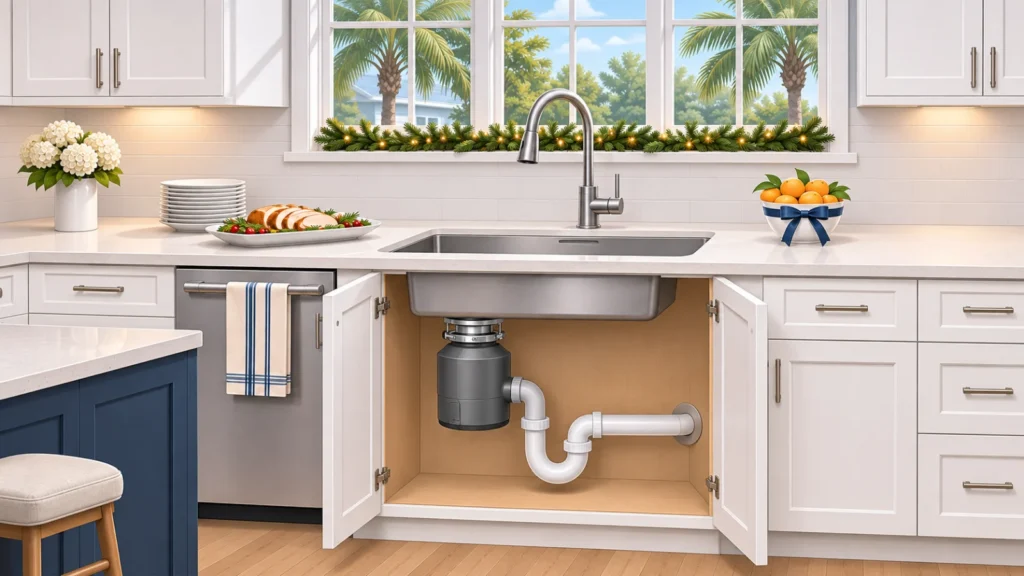
A disposal is built to grind small scraps, not to replace the trash can. Holiday menus are full of foods that are hard on it.
- Peels and starches. Potato peels and leftover mashed potatoes turn into a thick paste that can clog the drain line below the disposal. Pasta and rice swell with water and do the same.
- Stringy and fibrous scraps. Celery, onion skins, corn husks and green bean ends wrap around the moving parts and jam them.
- Bones and pits. Turkey and ham bones are too hard to grind. They can dull or stall the unit.
- Coffee grounds and eggshells. Both settle in the pipe and build up a gritty sludge over time.
When you do use it, run cold water before, during and after grinding. Feed scraps in a little at a time and let it finish before adding more. If it hums but won’t spin, switch it off at the wall. Many disposals have a reset button on the bottom and a socket for freeing a jam; your owner’s manual will show where. Never put your hand inside, even with the power off.
Plan for a busy guest bathroom
A guest bathroom that sits quiet most of the year gets heavy use when family visits. A little preparation saves an awkward moment and a wet floor.
- Keep a plunger in every bathroom. Guests are far more likely to deal with a slow toilet themselves if they don’t have to ask.
- Only toilet paper goes in the toilet. Wipes, even ones labeled flushable, paper towels and hygiene products don’t break down the way toilet paper does. Put a small trash can with a lid within reach.
- Fix small leaks now. A running toilet or dripping faucet is easier to repair before company arrives than in the middle of a visit.
- Find your main water shutoff. If a supply line bursts during a party, closing the main valve in the first minute limits the damage. Make sure you, and one other adult in the house, know where it is and that it turns.
Get your water heater ready for a full house
Back-to-back morning showers are when a water heater shows its limits. Before the guests arrive, give yours a quick check.
- Check the temperature setting. The U.S. Department of Energy says most households only need 120°F. The Consumer Product Safety Commission urges the same setting, because water at 140°F can cause a serious burn in about six seconds. The CPSC notes that most tap water scald injuries happen to older adults and children under five, which is worth remembering when grandparents and grandkids are both visiting.
- Know how much hot water you have. A tank heater’s first-hour rating is the number of gallons of hot water it can supply in an hour, starting with a full tank. The Department of Energy says you’ll find it on the yellow EnergyGuide label. If your home regularly runs out, your busiest hour may need more than the tank can give.
- Spread out the demand. Run the dishwasher and washing machine at night, and space showers a few minutes apart. A tankless heater is sized by how many gallons per minute it can heat, so running fewer fixtures at once helps it keep up too.
- Watch for warning signs. Rusty or cloudy hot water, rumbling or popping from the tank, water around the base or hot water that runs out sooner than it used to are all reasons to have it looked at before the house fills up.
If you’re weighing an upgrade, our guide to tank vs. tankless water heaters explains the trade-offs for Florida homes.
When it’s time to call a plumber
Some problems are more than a stubborn clog. Stop using water and call for help if you notice any of these:
- More than one drain backing up at once. A tub that gurgles when the dishwasher drains, or water rising in the shower when someone flushes, points to a clog in the main line.
- Sewage odor or water at a floor drain or cleanout. This usually means wastewater has nowhere to go.
- A leak from the water heater tank itself. A leak from the tank usually means the heater is near the end of its life.
- A disposal that stays jammed after you’ve reset it.
Skip the bottle of chemical drain cleaner on a serious clog. It rarely clears a main line, and it leaves caustic water standing in the pipe for whoever has to open it next.
Ready for a full house this holiday season?
365 Solutions is a Nocatee-based, licensed and insured plumbing and HVAC company serving Jacksonville, Ponte Vedra and St. Johns County. If a drain is slow or your water heater is struggling, call (904) 460-2998 or book online. We answer 24/7 for emergencies.
Related service: Drain Cleaning · Water Heater Services